THE FAKE HAVEN OF A BEACH UMBRELLA

Standard

by Elissa Caterfino Mandel

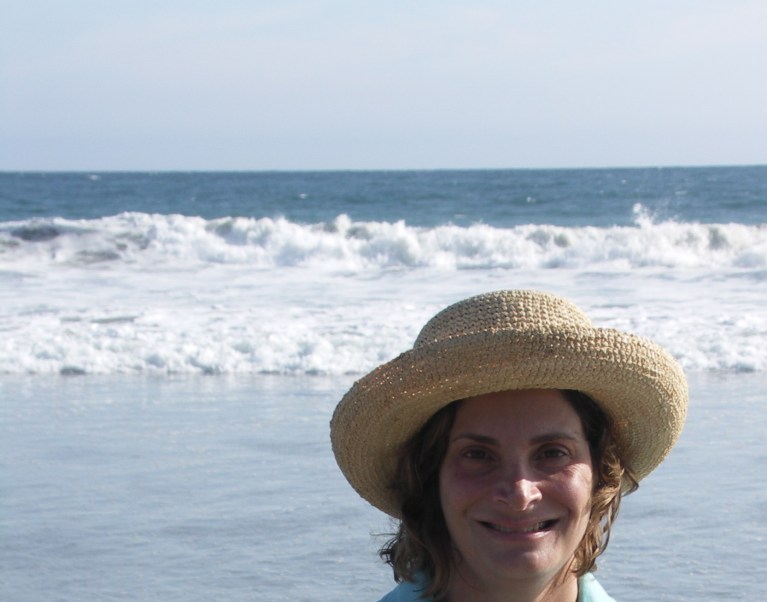
My beach alias wouldn’t be Surfer Girl; it would be Shade Searcher. Beach umbrellas and canopies are my preferred modes of beachwear. Sun counts as high risk.

But there we were in January at the Gaia Resort in Costa Rica, smack dab in the middle of a reserve for macaws and beachgoers. The beach was a shuttle ride away, and the resort sat on top of a major hill too treacherous for hiking in sandals.

It was also, apparently, too treacherous for the golf cart we were using to ride back to our room.

My story begins in that cart with a man who barely spoke English, and much as it sometimes seem that he and I speak a different language, I’m not referring to my husband. As the golf cart driver tried to power the cart up the hill, he pointed. Flapping the hand that he took off the wheel as if it were a wing, he gestured again. I think we were supposed to intuit that he saw a bird. “Macaws,” my husband said. The driver nodded, and he indicated the birds in a group of trees at eye level. Then the driver held up his phone, motioning for us to get out. We’d seen macaws before but at a distance, and this was an opportunity to capture them so they’d be more than colorful distant specks on our Iphones.

“Stay there,” Hal said to me. “Let me go first.”

If only. Hal’s feet tangled as he hopped out of the cart, and he ended up on his tush on the ground. Righting himself for a brief second on the uneven turf, he fell again, only this time it was over his perpetually untied shoelaces. From there somehow, he tumbled over the low retaining wall, and he began rolling down a hill. Ok. Let me mention that Hal is almost 70 years old. Let me emphasize that the hill was steep; hence, the retaining wall. Let me suggest that perhaps the photo-obliging golf cart driver never should have stopped the cart where he did; we were on the upward incline of a hill that was a calf killer the few times we’d walked it. And let me repeat that we were in Costa Rica in a beach community called Manuel Antonio; it’s miles from a major medical center, to say nothing of a decent restaurant.

I pictured the hospital bills, the broken bones, the paralysis… Had we even renewed our Medjet membership? That’s the thing you pay $500 a year for in hopes you never actually use it. It transports you by air, free of charge, to the best medical center in your relative vicinity. I can see the envelope now, sitting home, unopened in the box in my kitchen, on my perennial to-do list.

Midway into Hal’s third roll, he was stopped by the very same tree where the macaws once perched. They were no longer there. They’d been scared away by the sound of me screaming.

By this time, I was out of the cart, and it wasn’t until Hal stood up and started laughing that I breathed. Oh, good. This would be relegated to the annals of “funny vacation story,” like the time I’d inadvertently stepped into the wading pool at the Hollywood Hyatt in my sneakers because I had a book in my face and my reading glasses on.

In retrospect, the most disturbing thing about the incident is that our golf cart driver just sat there. He never asked how Hal was or indicated he was concerned in any way. Maybe he didn’t have the English skills to express the horror of what he had witnessed. Perhaps he thought Hal and I were engaged in some kind of weird American mating ritual. As he took us the rest of the way to our room, we were laughing so hard I worried he thought we were drunk.

A few weeks later Hal was in the rheumatologist’s office, and the doctor noted that his wrist was swollen. “Have you fallen recently?” she asked. He shook his head. Nice to have blocked the whole thing – unlike me, he doesn’t have the horror film “Narrowly Averted Medical Apocalypse” playing in his brain.

Maybe it’s fluid from gout, she said, and she suggested draining it with a needle. Luckily Hal said no. It was only the next day that he remembered about his topple into the jungle. We never did get a good picture of the macaws.

But the image of Hal, rolling on the hill? That one’s permanently etched in my brain.   It’s like the thing behind the door in the horror movie that never actually gets out, but you somehow know it’s there, waiting for you. I only hope when it comes, we will be able to do what we did this time – ride off as we laugh it away.


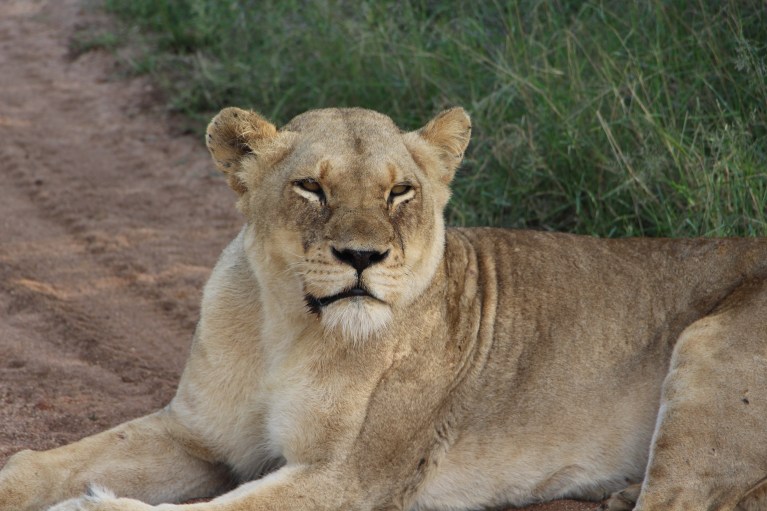
ELEPHANTS IN THE PLUNGE POOL “Hello, I’d like to be connected to the lions.”

Standard

by Elissa Caterfino Mandel

If you don’t wear your glasses and have a wonderful imagination, the Quarry, which backs up to our townhouse, looks like the Grand Canyon.  Because of the way our half-of-a-house sits — at a safe distance from where the birds and other wildlife congregate — experiencing nature through the windows is like watching it virtually. It’s theoretical; it’s distant; it almost seems fake. For the leery, it’s perfect.

The elephants, however, were real.

We’d spotted them one chilly afternoon 8,000 miles from the Quarry, an entire herd, and they were using their trunks to drink from the plunge pool that sat behind our unit. All that separated us from about 20,000 pounds of elephants was a tenuous sliding glass door.  Could the elephants see us?  More aptly, what did they want from us beside pool water?

Proximity to jungle animals — this was what we had wanted when we went on safari, wasn’t it? However,  outside our door on the deck that touched our unit seemed a little too close.

“Are you getting it?  Are you getting it?” I asked Hal, who was using his weapon of choice to tackle the elephant invasion — Iphone video.

As he filmed, something unpleasant occurred to me.   “Do you think they can see us?”  I said.  Frantically, I began Googling “eyesight of adult elephants”.    Did I really think they were going to spot me in my towel and charge,  marauders through our sliding glass door? Given that we were accompanied to our lodge every night by a guard with a gun?  Well, yes: I did think that.

Un-summoned, the elephants remained for about a half hour — sipping messily with their trunks at the plunge pool, where I had been swimming less than 24 hours before.  It seemed ironic.  The day before, we’d been searching for them for hours with a guide in a jeep.  If I had known getting the elephants to come was as simple as inviting them to my back deck for a swim, I never would have gotten up at five in the morning to search for them.  After this, we could try for the lions.

“The elephants in our plunge pool” is what our Facebook caption ultimately said. “Our” plunge pool? Really? What made it ours?  If anything, it was a pool we were borrowing, and it’s not clear from whom. The safari lodge? Or were we using something that really belonged to the jungle? Who should the elephants have asked permission to drink from our plunge pool? The lions?

I still remember how the tiniest elephant in the group tried to maneuver her extremely short trunk into the plunge pool and reach for some water.  “I feel like I should carry out some Poland Spring,” said Hal, who must have had a secret wish to be trampled.

Next, he’d be providing the fox that we sometimes see at home in the Quarry with lemonade.

Everyone around me talks about having a bucket list. Africa was on mine; specifically a safari. It’s easy to sit in a jeep in your khaki best and check off the boxes. I’ve seen the big five – elephants, rhinos, hippos, lions and giraffes; I’ve hiked – well, at least partially hiked — Table Mountain.   It’s the memory of that plunge pool drink fest that will stick with me — and a few weeks later my granddaughter’s wonderful two-year-old voice saying, “I want to see picture of effants.”

A day after we filmed the elephants, we heard that a bunch of fish had been electrocuted in a pond because of a lightning strike, and we saw the evidence from our safari jeep – hundreds of lifeless eels floating on top of the water. I remember that to comfort herself about the prospect of death, my niece used to go around talking about the circle of life. Sad as it was to witness, the eels’ untimely death seemed like the personification of that very idea. Wrong pond, wrong time; oh, well.

A year and three months later, I think mostly about the baby elephant, the one whose trunk couldn’t reach the pool water. I suspect I’ll never go back to Africa to ask the question about chlorination in the plunge pool water and the health of the elephants who drank it. But as I sit and look at the birds flying around the Quarry, I wish I were the kind of person who would lobby more for the well-being of the things I see every day, even if it meant I were to travel less.


HEARTBREAK WEEKEND

Standard

by Elissa Caterfino Mandel

My husband and I only made it to 1963.  The Birmingham Civil Rights Institute was serpentine, chock full of heart-wrenching detail.  Impossible to navigate in the hour we had.  The Confrontation Gallery waylaid us — mostly because of the holograms.  There they were — projections of African Americans from the past, from behind bars, testifying about the slave trade. Every story was compelling, each with its own version of misery. “They held me for hours without food.”  “They took away my children.”   “I was cold and tired.”  Unfortunately, I’m paraphrasing because I don’t remember the exact words.  But I cannot shake the haunted faces – or the idea that this is still happening in other parts of our country.

Starting last Thursday, in honor of Black History Month, a group from our temple flew south. We were there for one reason. And it had nothing – well maybe a little — to do with BBQ. We followed a small part of the route of the Civil Rights trail. After flying to Atlanta, we journeyed to Alabama by bus, 31 temple members in all, plus the rabbi, cantor, tour guide and bus driver.

Our days were full – the Rosa Parks Museum; The Equal Justice Initiative; The National Memorial For Peace and Justice; The Edmund Pettus Bridge; The NAMES Project Foundation; a service at the Ebenezer Baptist Church in Atlanta.  It was like binge watching atrocity.

This journey was the temple’s first attempt to organize for adults what has traditionally been a youth group trip.  One mom on the trip had a son who’d ridden the bus the previous spring. They were constantly texting stories back and forth.

Our story began when we found our seats on the bus — at 8:30 in the morning – for a day that would end up being 16 hours long.   Boarding that bus, we were blissfully, or maybe stupidly, unaware that once we crossed into Alabama, we’d cross into a different time zone. Soon we’d learn it would also be a different dimension.

It’s not that the Southerners we met weren’t friendly.  At the Kiddush after a Shabbat service in Montgomery, my husband and I were invited to join a few local couples at their weekly dinner at Noodles.  (We couldn’t go but appreciated the invitation.)  At a church service in Atlanta two days later, the preacher announced TSTI by name, and congregants walked through the aisles to shake our hands.  Maybe by virtue of how we’d agreed to spend the weekend, we were like honored guests.  But guests can leave and go back to their lives

Of course, I knew many of these civil rights stories before.  I’d listened to lectures on them, read books, watched movies.  But for me, there is something different about having an experience seared into your memory through your hands, as activist Joanne Robinson suggested when we were in Selma. (She demanded that we pick up rocks from a schoolyard where activists once gathered. She wanted us to know how it felt to touch the same ground as people who had done such important work. )

It’s meaningful also to feel something in your feet, as when we walked across The Edmund Pettus Bridge, the site of Bloody Sunday. (We briefly retraced the route of freedom marchers attempting to get to Montgomery, only we walked in relative comfort. Granted it was only about 40 degrees, but we did not have to contend with tear gas, rampaging horses or police-wielded clubs.)

It’s earthshaking to hear your voice singing hymns with an 85-year-old bishop recounting his stories in a Birmingham park.   “Praise Jesus,” he sang as he raised his hands over his head, prompting us to do the same.  The story that moved me, the one I hope I don’t forget, is about the time in 1968 when he drove Dr. King to the airport for a flight to Memphis. It was the last time he saw Dr. King alive.

I had been excited about visiting Alabama, to add it to the list of states I’d visited.  Walking on the grounds of The National Memorial for Peace and Justice in Montgomery, I was impressed by the depths of my ignorance.  The Memorial contains tombstones of the lynched, 4400 people in all. And those were just the names that made it into the records.  Some of these monuments are on the ground, others suspended.  They’re made of corton steel, forbidding in their number, which, I learned later, is 800. Each monument represents a different county where a lynching occurred.

Until I read the inscribed names, I didn’t realize how many people had been lynched; I had no idea that lynching had occurred on a daily basis for so long.  Somehow I knew the names of Emmett Till and Leo Frank but not the thousands of others.  Reading the inscriptions, the group tallied as many as 50 people gone in a single county in a single day.  There were men, women, and children murdered for contrived infractions like smiling at the wrong person.

In one section, the slabs hung down from the ceiling, like bodies hanging from a tree.  I walked with my head lifted to make sure I could see the names. People with their eyes on the sky can easily collide with the steel.  Maybe that’s the point — to collide with the steel, to physically feel the pain.

Each slab has a double, aligned in rows on the ground so as to reinforce the tragedy’s magnitude. The hope is one day the offending counties will reclaim, and exhibit, their slabs, thereby owning their legacies.  The Memorial’s almost a year old.  So far all the slabs remain.

When I returned home, people asked, ‘how was your vacation’? Hmm. I feel grateful for the experience because of the members of the temple I now know a little better, including Rabbi Cohen and Cantor Moses. But I wouldn’t use the word vacation to describe the weekend.  It was, in fact, a reverse respite – a tough time, mitigated by the awareness that I knew I would go home after three days.

I’d like to think I would follow the example of other temple members I met on the trip.  One volunteers for CASA.  Another woman has journeyed to the Texas-Mexico border to work with seekers of asylum.  And those are the only the ones I know about.

Now I am left with questions.   Most notably, how do I make sure this isn’t something that is just another memory? I don’t want it to return a year from now, brought back to me only on Facebook.  (Out of habit, I did post photos.)  But it’s not about “being seen” as a humanitarian.  It’s about being one.  I don’t have to go as far as I did last weekend to do something meaningful. There are umpteen people a few short miles from South Orange, maybe even in South Orange, who might need assistance. Would all they want from me were my “Kilroy was here” pictures?

Maybe the best way to have the experience last is to do what Rabbi Cohen and Cantor Moses suggested: to make a concerted effort to listen better. It’s not just listening, though. It’s seeing, also. Seeing differently. Taking opportunities to view the world through the lens of “the other”.  Both the rabbi and cantor advised caution.  Don’t just jump in, assuming you know better, they said.  Someone this weekend quoted something in passing that I know I’d heard before.  But this time it resonated. “God gave us two ears and one mouth, so we ought to listen twice as much as we speak.”

The journey we took was sponsored by an organization called Etgar36. For more information, go to www.etgar.org or call 404-456-6605.